What Is Pipcross?
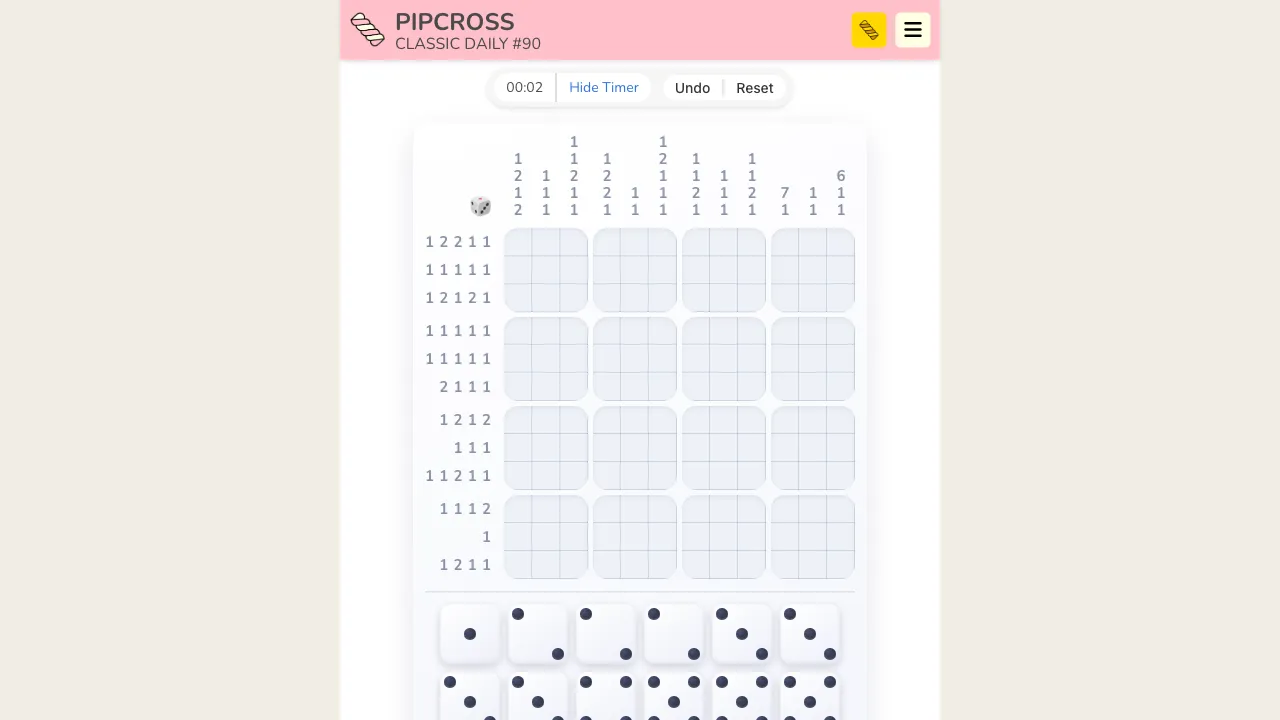
Pipcross combines a 3×3 set of dice with line clues inspired by nonograms. You place nine dice so the visible pip patterns across rows and columns match the clues around the board. Each die contributes a value and position, turning a familiar object into a compact two-direction constraint puzzle. A die chosen for one row also affects a column, so local matches must be checked against the entire grid. Strong clues can force a value or sequence, while the limited collection of dice prevents unlimited repetition. The result is part arrangement problem, part arithmetic pattern matching, and part exact-cover logic.
How to Play Pipcross
- Read every row and column clue and determine what pip totals, runs, or patterns they require.
- Identify forced values or positions created by the most restrictive lines.
- Place the nine available dice while checking each move in both directions.
- Finish when all dice are used and every horizontal and vertical clue is satisfied at the same time.
What Makes Pipcross Stand Out
Pipcross looks tactile and approachable because its symbols are just dice pips, yet the crossed clues create a dense logical system in only nine cells. It is distinct from domino-placement games despite the similar word 'pip': here, individual dice and nonogram-like line information drive the solution.
Strategy Tips for Pipcross
- Begin with the line that has the fewest possible dice combinations.
- Maintain a clear inventory of unused values after every placement.
- Use crossing clues to confirm a cell before locking an entire row.
- If the last line fails, revisit the earliest placement based on a choice rather than a forced deduction.
Who Will Enjoy Pipcross?
Pipcross is suited to nonogram players, dice-puzzle fans, and solvers who enjoy small grids with tightly coupled constraints. Its symbols are language-light, but understanding how the line clues encode pip arrangements is essential.