What Is Pedantix?
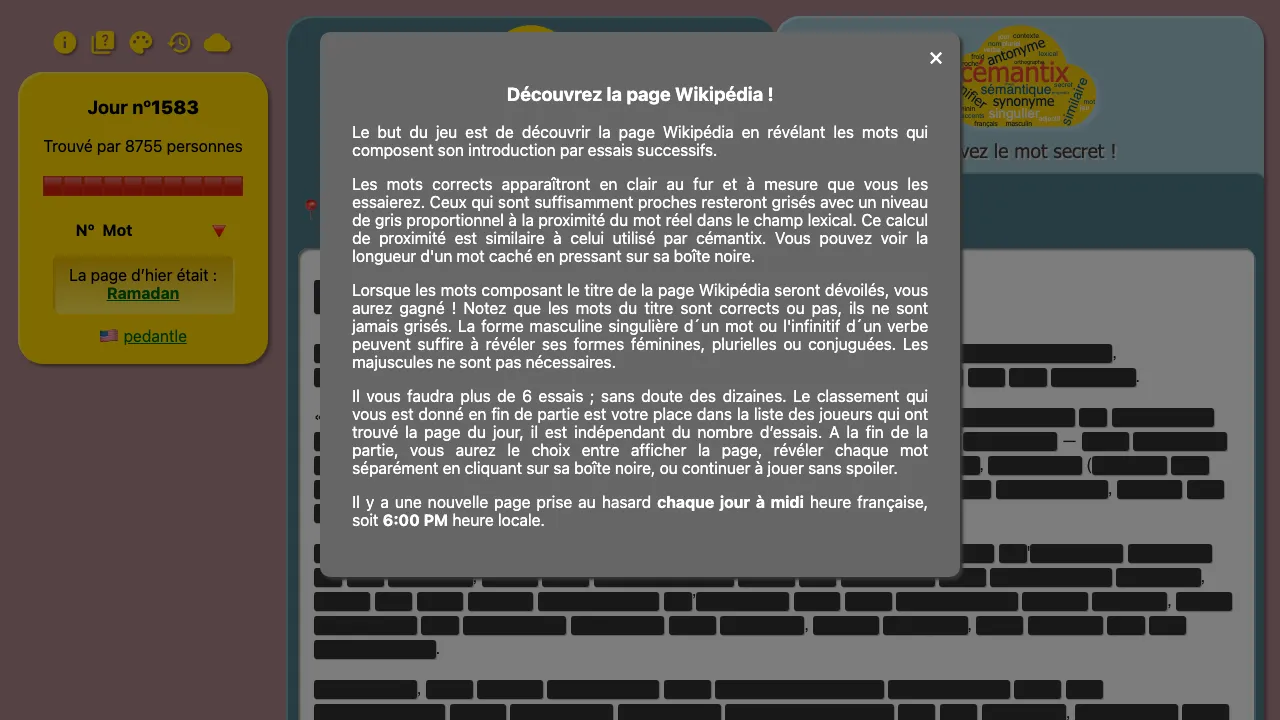
Pedantix is a daily French browser puzzle built around a hidden Wikipedia article. At the start of each game, the title and introductory text are largely concealed, while spaces, punctuation, formatting, and some special characters remain visible. Your job is to type French words one at a time. When a guess matches a word that appears in the hidden introduction or title, the matching text is revealed. Related forms can also help expose the structure of the passage. The ultimate goal is not to reveal every word in the article. You win when you uncover the words that make up the article title. Pedantix is closely related to Cémantix, but the two games feel quite different. Cémantix asks you to find one secret word through semantic similarity, while Pedantix gives you an entire masked encyclopedia introduction to investigate.
The Core Pedantix Twist
Pedantix combines vocabulary, semantic clues, reading comprehension, and general knowledge. A new puzzle begins as a block of hidden text: ██████ ███████ est un ██████ français... You then test words that might occur in the introduction. If you guess a word that is actually present, its occurrences become visible in their original positions. The newly exposed context can suggest more useful guesses. A typical progression might look like: france - ville - histoire - siècle - architecture - monument The exact path changes every day. One article might be about a scientist, another about a city, a historical event, an animal, a work of art, or a technical concept. Pedantix also uses semantic proximity. A guess that is not an exact hidden word can still indicate that you are conceptually close to part of the text, helping you explore the right vocabulary.
How To Play Pedantix
- Study the masked introduction. Look at sentence lengths, punctuation, parentheses, dates, hyphens, and the visible structure of the title before typing anything.
- Try broad French words. Test useful concepts such as France, ville, histoire, science, guerre, art, espèce, or siècle to discover the article's general domain.
- Read every revealed fragment. Once several words appear, stop guessing randomly and use the emerging sentences to identify likely topics, places, people, dates, or categories.
- Narrow toward the subject. Guess increasingly specific vocabulary connected to the strongest clues you have uncovered.
- Reveal the title. The game ends when all of the words in the hidden Wikipedia page title have been found.
Understanding Exact Matches and Semantic Clues
Pedantix gives you more information than a simple correct-or-incorrect response. Exact Matches When your guess corresponds to a word used in the hidden passage, matching occurrences are revealed in the text. This can expose important grammatical and factual context. For example, revealing né, français, and a four-digit year near the start of a sentence strongly suggests that the article may describe a person. Related Word Forms The game can account for grammatical variations such as gender, plural forms, and conjugated forms. This means a useful root word may uncover a form you did not type exactly. Semantic Proximity Some guesses can be marked as conceptually close even when they are not exact matches. A warm semantic clue tells you that a hidden word is related in meaning to your guess. If musique appears semantically promising, it may be worth exploring terms such as compositeur, chanson, instrument, album, or orchestre. The key is to treat proximity as a direction rather than an answer.
A Realistic Example of the Deduction Process
Imagine that the hidden introduction gradually reveals fragments equivalent to: ... est une ... située en France ... département ... habitants ... You do not need to know the title yet. Those words already suggest a geographic article, probably a commune or city. Useful next guesses might include: commune ville région population maire If another fragment reveals a particular region or nearby city, you can move from generic geography words to specific place names. The same method works for other article types. If you reveal words related to birth, profession, works, and nationality, the target is likely a person. If you reveal species, family, habitat, and distribution, it is probably a biological article.
Tips & strategy
Start with a vowel-rich opener, never reuse letters you know are absent, and think about common letter patterns before your final guesses.