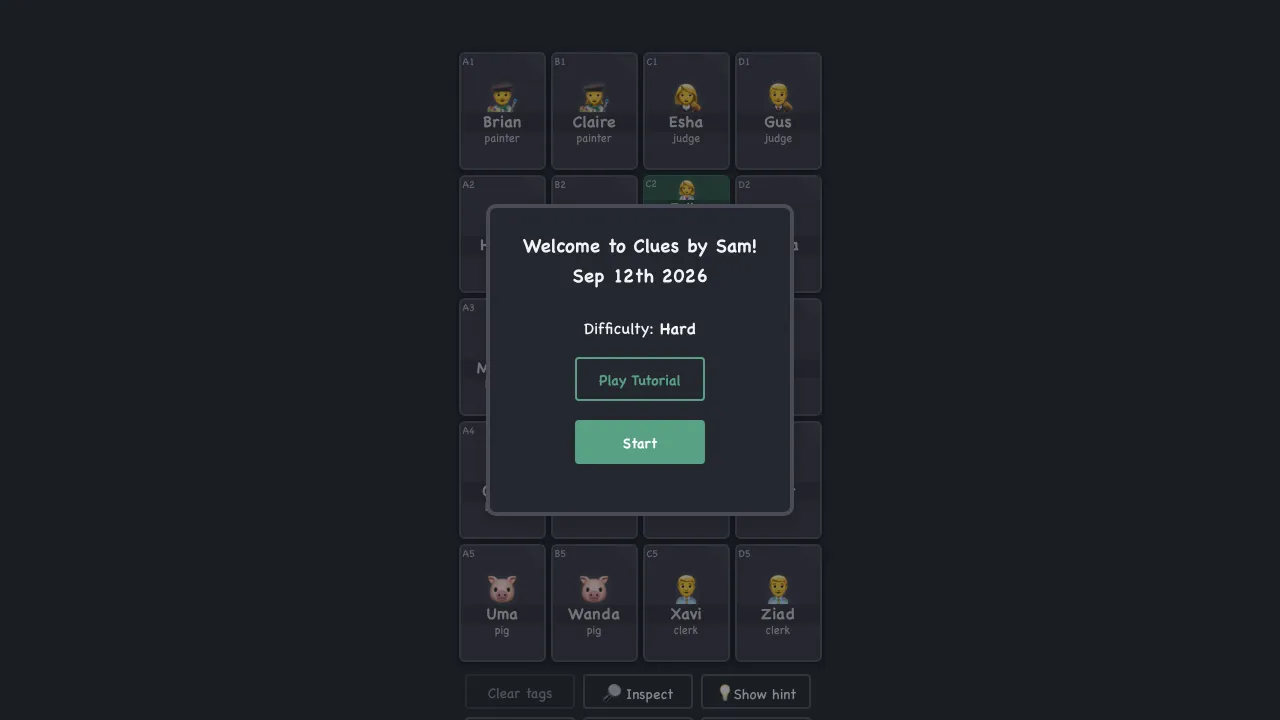
What Is Clues by Sam?
Clues by Sam presents a small cast of suspects and a set of statements about the day's crime. Your job is to determine who is guilty by combining the clues, eliminating contradictions, and tracking what must be true. The promise of a no-guess solution is important: every conclusion should follow from information on the board. The week supplies a natural difficulty curve, with later cases generally asking you to hold more relationships in mind. A clue might place one character next to another, rule out an object, or connect a person with a time or location. Marking those relationships converts narrative details into a clean deduction grid, and each confirmed fact narrows the remaining possibilities.
How to Play Clues by Sam
- Read the case and identify the categories being matched, such as suspects, objects, places, or times.
- Record direct facts first, including both positive matches and explicit exclusions.
- Propagate each fact across the remaining possibilities so every row and category stays consistent.
- Accuse the culprit only when the full set of clues leaves one logically complete solution.
What Makes Clues by Sam Stand Out
Clues by Sam turns classic logic-grid reasoning into a friendly daily mystery. The characters and crime framing give the deduction personality, while the fixed daily case makes discussion possible without requiring competitive speed. Its insistence on logical solvability also makes mistakes diagnosable: a contradiction usually points back to a specific assumption.
Strategy Tips for Clues by Sam
- Separate confirmed information from possibilities; do not treat a plausible story as evidence.
- Whenever one option is confirmed, immediately eliminate it from every competing row or column.
- Translate compound clues into smaller statements before combining them with the grid.
- If the board contradicts itself, undo the newest inference and trace whether it was stated or merely assumed.
Who Will Enjoy Clues by Sam?
This game is made for fans of logic grids, compact mysteries, and methodical deduction. It also works well for players who dislike vocabulary barriers or random guessing, since progress comes from relationships inside the case rather than outside knowledge.