What Is Capitalibrate?
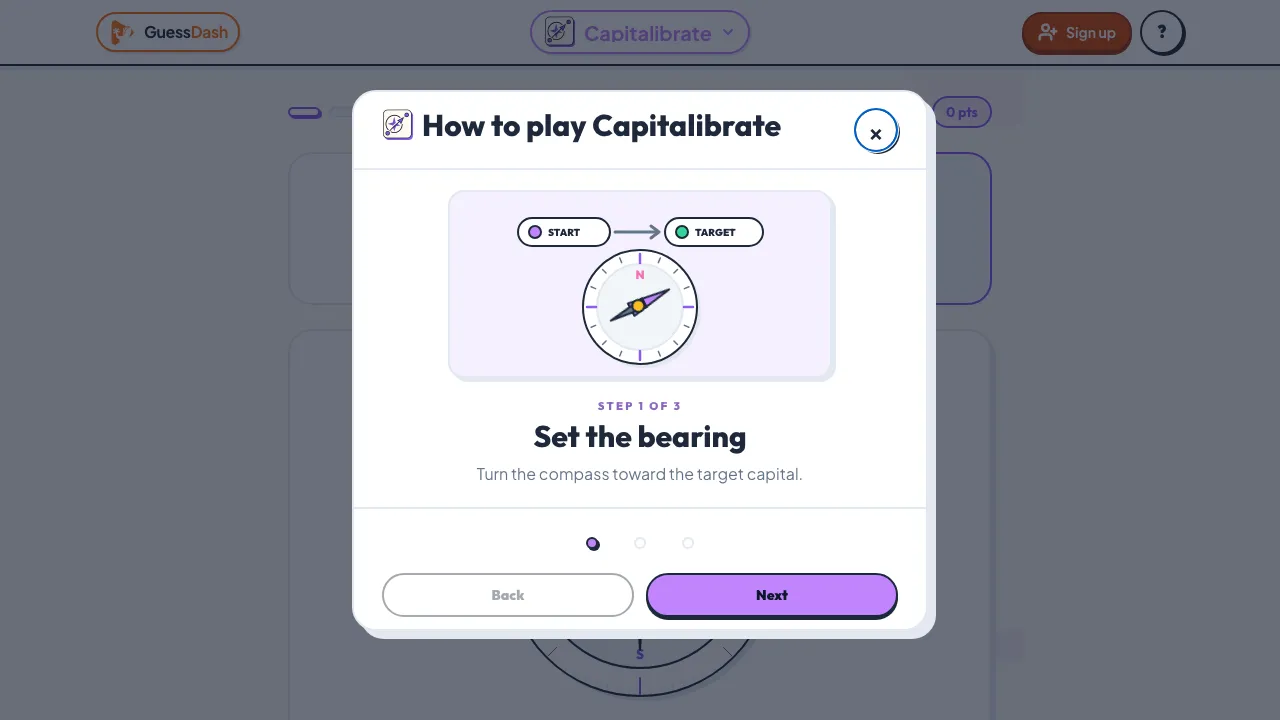
Capitalibrate begins with a known capital and names a target capital. Instead of locating the target directly on a labeled map, you aim along a compass direction and estimate how far away it lies. The result tests the relationships among capitals rather than isolated memorization. Each answer combines two judgments. Direction requires a mental bearing from the starting city, while distance requires a sense of global scale and latitude. A guess can be close on one dimension and poor on the other, giving useful feedback about whether your internal map has the right orientation and spacing.
How to Play Capitalibrate
- Locate the starting capital mentally and place the target in its broad region or continent.
- Estimate the compass bearing by comparing their relative latitude and longitude.
- Judge the distance using known city pairs, continental widths, or the scale of a quarter of Earth's circumference.
- Submit the aim, inspect the actual route and error, and apply that calibration to the next daily comparison.
What Makes Capitalibrate Stand Out
Capital quizzes usually ask for names or countries. Capitalibrate assumes the names are known and tests how they relate in space. That makes every round a calibration exercise, with wrong answers teaching direction and scale instead of simply revealing a fact.
Strategy Tips for Capitalibrate
- Break the route into a rough north-south component and east-west component before choosing an angle.
- Use familiar benchmarks, such as the width of Europe or a transatlantic flight, to estimate distance.
- Remember that lines of longitude converge toward the poles, reducing east-west distance at high latitudes.
- Study whether your guesses consistently run long, short, clockwise, or counterclockwise and correct that bias deliberately.
Who Will Enjoy Capitalibrate?
Capitalibrate is best for capital-city learners, GeoGuessr-style map fans, travelers, and estimation players who enjoy directional reasoning. It is more spatial than a conventional capital quiz and more knowledge-based than a blind coordinate game.